






All Categories
Show more

Posts

Why You Keep Repeating the Same Painful Patterns — And How Childhood Shaped Everything

Why You Keep Repeating the Same Painful Patterns — And How Childhood Shaped Everything

Article | Mental health
Your childhood didn't just shape your memories — it wrote the rules your relationships still follow today. Here's why painful patterns keep repeating, and what it actually takes to stop them.
How to Build Real Confidence — And Why Positive Thinking Alone Won't Get You There

How to Build Real Confidence — And Why Positive Thinking Alone Won't Get You There

Blog | Self-esteem
Most people try to fake confidence until it appears. But that strategy has a serious flaw. Real confidence isn't performed — it's earned. Here's what psychology actually says about building it from the ground up.
Overthinking

Overthinking

Article | Mental health
Overthinking is not always a sign of awareness... sometimes it is simply the mind's attempt to control anxiety. When we continuously replay the exact same scenarios in our heads, we are fundamentally trying to avoid a potential mistake or an anticipated pain.
Tranquility Isn't in Those Around You… Tranquility Is Within You

Tranquility Isn't in Those Around You… Tranquility Is Within You

Article | Life
Comfort is about your nervous system itself remaining calm, no matter what is going on around you. From a psychological perspective... a person is not exhausted by the events themselves, but rather by their response to them.
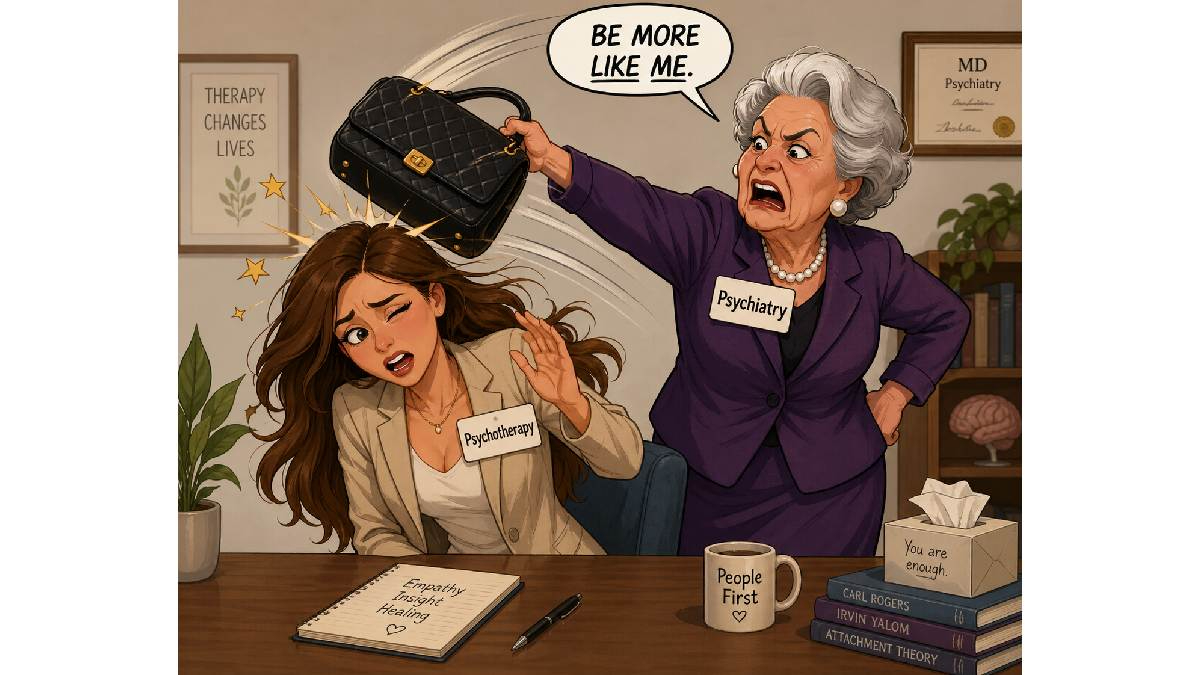
Psychotherapy Needs to Divorce Psychiatry

Psychotherapy Needs to Divorce Psychiatry

Article | Psychotherapy
You have to understand that there are two ways of studying the mind: from the inside or from the outside. Traditionally, psychology was on the inside (Freud, Jung etc) but with the modern iteration of “neuroscience” psychology quietly changed lanes to the outside (Moncrieff, 2008). The problem is that people who are suffering from poor mental health need explanations that make sense on the inside and traditionally that has been the job of psychotherapy, which was on the inside but over the last few years, psychotherapy has come under pressure to use mechanistic models (outside) to explain their patients symptoms and it’s not working.
Why You Were Raised to Be Convenient — Not Happy

Why You Were Raised to Be Convenient — Not Happy

Blog | Self-acceptance
The voice that says you're not enough? It started long before you had a say. Learn why childhood programming runs so deep — and what actually works to change it.
Codependency Signs You're Probably Ignoring

Codependency Signs You're Probably Ignoring

Article | Codependency
You over-apologize, avoid conflict, and always put others first. Sound familiar? Here are the real signs of codependency — and where to start building boundaries that actually hold.
Why You Feel Lonely Even When You're Surrounded by People

Why You Feel Lonely Even When You're Surrounded by People

Article | Relationship
You have people around you — and still feel completely alone. That's not a personal failure. It's a signal. And once you understand what it's actually telling you, everything shifts.
8 Personality Types Based on Your Core Emotion — Which One Are You?

8 Personality Types Based on Your Core Emotion — Which One Are You?

Article | Emotions
Your personality isn't random — it's built around one dominant emotion. Plutchik's model maps 8 core emotions to 8 distinct personality types. Find out which emotional pattern quietly runs your life.
The Psychology of Attention Fragmentation (Post-Short-Form Era)

The Psychology of Attention Fragmentation (Post-Short-Form Era)

Article | Life
Constant micro-content consumption fragments attention, altering cognition, memory retention, and emotional regulation in modern digital environments.
You need to be logged in to send messages
Login Sign up
To create your specialist profile, please log in to your account.
Login Sign up
You need to be logged in to contact us
Login Sign up
To create a new Question, please log in or create an account
Login Sign up
Share on other sites

If you are considering psychotherapy but do not know where to start, a free initial consultation is the perfect first step. It will allow you to explore your options, ask questions, and feel more confident about taking the first step towards your well-being.

It is a 30-minute, completely free meeting with a Mental Health specialist that does not obligate you to anything.

What are the benefits of a free consultation?

Who is a free consultation suitable for?

Important:

Potential benefits of a free initial consultation

During this first session: potential clients have the chance to learn more about you and your approach before agreeing to work together.

Offering a free consultation will help you build trust with the client. It shows them that you want to give them a chance to make sure you are the right person to help them before they move forward. Additionally, you should also be confident that you can support your clients and that the client has problems that you can help them cope with. Also, you can avoid any ethical difficult situations about charging a client for a session in which you choose not to proceed based on fit.

We've found that people are more likely to proceed with therapy after a free consultation, as it lowers the barrier to starting the process. Many people starting therapy are apprehensive about the unknown, even if they've had sessions before. Our culture associates a "risk-free" mindset with free offers, helping people feel more comfortable during the initial conversation with a specialist.

Another key advantage for Specialist

Specialists offering free initial consultations will be featured prominently in our upcoming advertising campaign, giving you greater visibility.


It's important to note that the initial consultation differs from a typical therapy session:

No Internet Connection It seems you’ve lost your internet connection. Please refresh your page to try again. Your message has been sent

